Education is the cornerstone of individual and national growth. History shows that nations hindered by widespread ignorance cannot achieve their full potential. India is currently engaged in a vital struggle for 100% literacy, yet flagship programs have been insufficient to meet our goals due to complex challenges like corruption, political hurdles, teacher qualifications, and infrastructure deficiencies.
Many Non-Governmental Organizations (NGOs) have stepped in to support government efforts, but true, concrete change requires focused and continuous intervention.
After three years of dedicated work with government school students, we identified a critical gap: a lack of teacher concept clarity and an over-reliance on outdated, verbal (rote) learning methods. Children, especially in grades 5th, 6th, and 7th (and all age groups), are highly receptive to visual learning. We believe that for any social program to be successful, the intervention cycle must be complete.
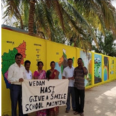
We have addressed this need by reinventing existing visual learning concepts (like WALA – Wall as Learning Aid/ BALA- Building as Learning Aid) by turning classroom walls into active worksheets and essential teaching aids. This unique program is called HASI—GIVE A SMILE.
We launched “Hasi—Give a Smile” because the look of understanding and joy on a child’s face—the ‘smile’—is priceless. Our goal is to make learning interesting and ensure students achieve genuine conceptual clarity.
Government school teachers currently rely primarily on Linguistic (verbal) methods, which heavily encourages memorization rather than understanding. Students often just reproduce text in exams without grasping the underlying concepts. Other crucial learning styles, such as Logical (Mathematical) and Spatial (Visual), are largely neglected.
It is widely recognized that visual learning significantly enhances retention and improves concept clarity. To implement this effectively:
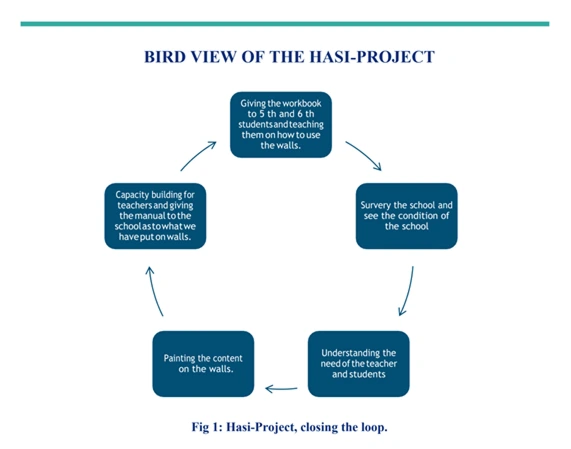
The HASI-Project is designed as a closed-loop cycle (as illustrated by the Fig 1: Hasi-Project, closing the loop diagram). Its successful implementation and advantages are structured as follows:
| Step | Implementation Process | Key Advantage & Outcome |
|---|---|---|
| 1. School Selection | Select schools with good infrastructure and a willingness from teachers/Head Masters (HMs) to adopt new methods. | Ensures buy-in and successful adoption of the new teaching methodology, leading to an organic increase in admissions by making the school attractive and effective. |
| 2. Need Assessment | Understand the specific content and pedagogical needs of the teachers. | Guarantees that the painted content is relevant and targeted to fill specific knowledge gaps. |
| 3. Wall Painting | Paint the content (textbook concepts converted to visuals) onto the classroom walls. | Provides a permanent, always-present, and engaging visual aid that supports every lesson. |
| 4. Teacher Training | Teach the teachers how to use the painted walls effectively and provide a detailed manual. | Closes the loop on teacher clarity and ensures the new tool is utilized properly, leading to continuous, focused intervention. |
| 5. Resource Distribution | Distribute corresponding workbooks (for 5th and 6th standard students). | Reinforces the visual learning with active practice, completing the intervention cycle and maximizing learning retention. |
The ultimate advantage of HASI is that it moves beyond mere surface-level attraction to become a powerful, teacher-supported, and conceptually-driven intervention that fundamentally transforms the learning experience.
We are proud to share that the HASI—Give a Smile program has successfully transformed the learning environment in 8 schools to date. Every school listed below represents a partnership committed to fostering concept clarity and visual learning for its students.
Schools Impacted:
This service is perfect for individuals, volunteers, or smaller NGOs who want to execute the painting themselves but need professional guidance on the educational content.
For corporations or large organizations (CSR partners) looking to adopt schools and conduct a painting drive, we manage the entire project from planning to execution, offering a powerful volunteering opportunity.
We partner directly with schools (both government and private) that recognize the need for enhanced visual learning environments.
At Vedan, we don’t just manage problems — we redesign systems, empower communities, and create models that continue long after we leave. Your support helps scale solutions that are practical, measurable, and replicable.